

Prescursor to the French Revolution
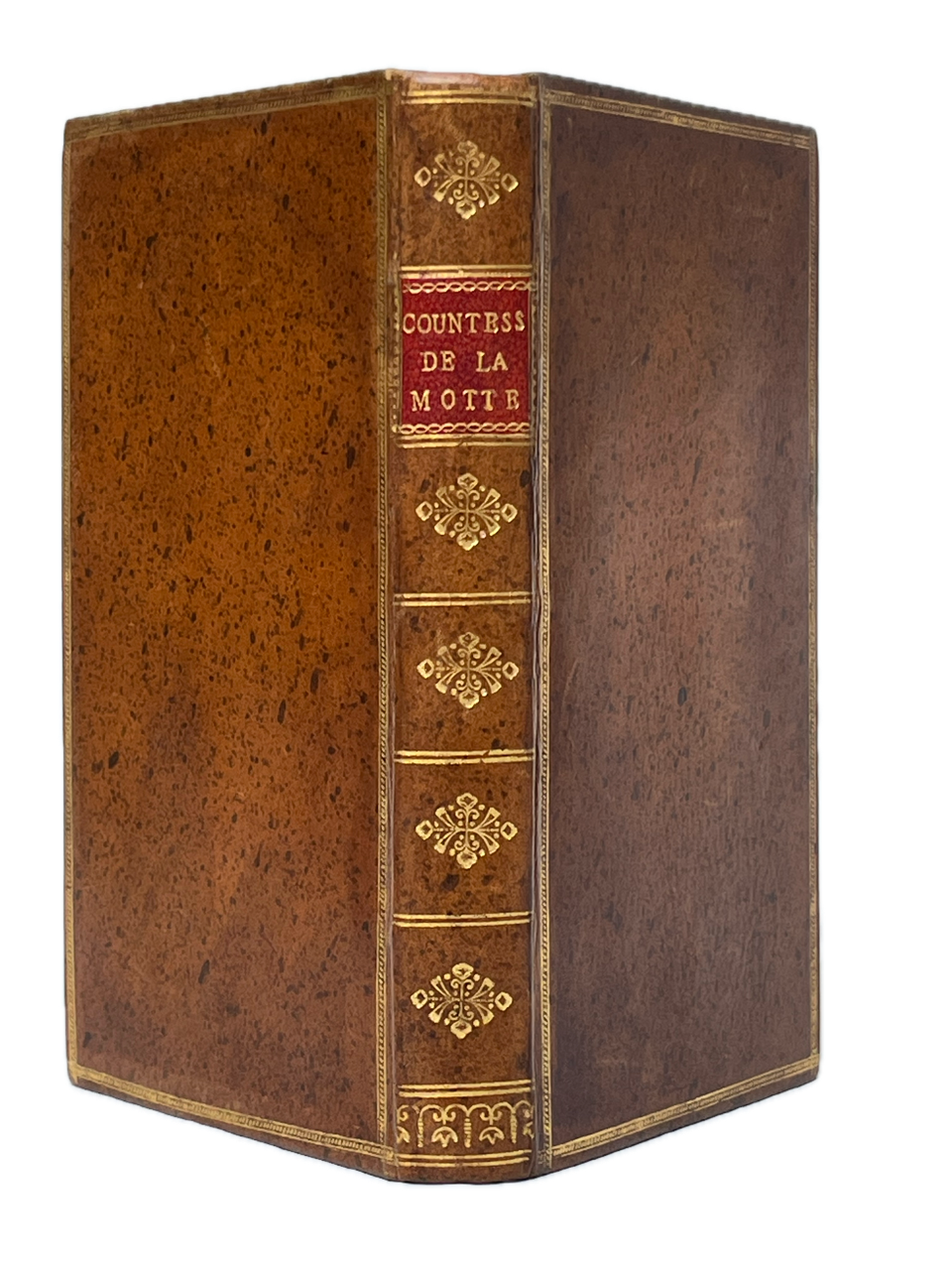
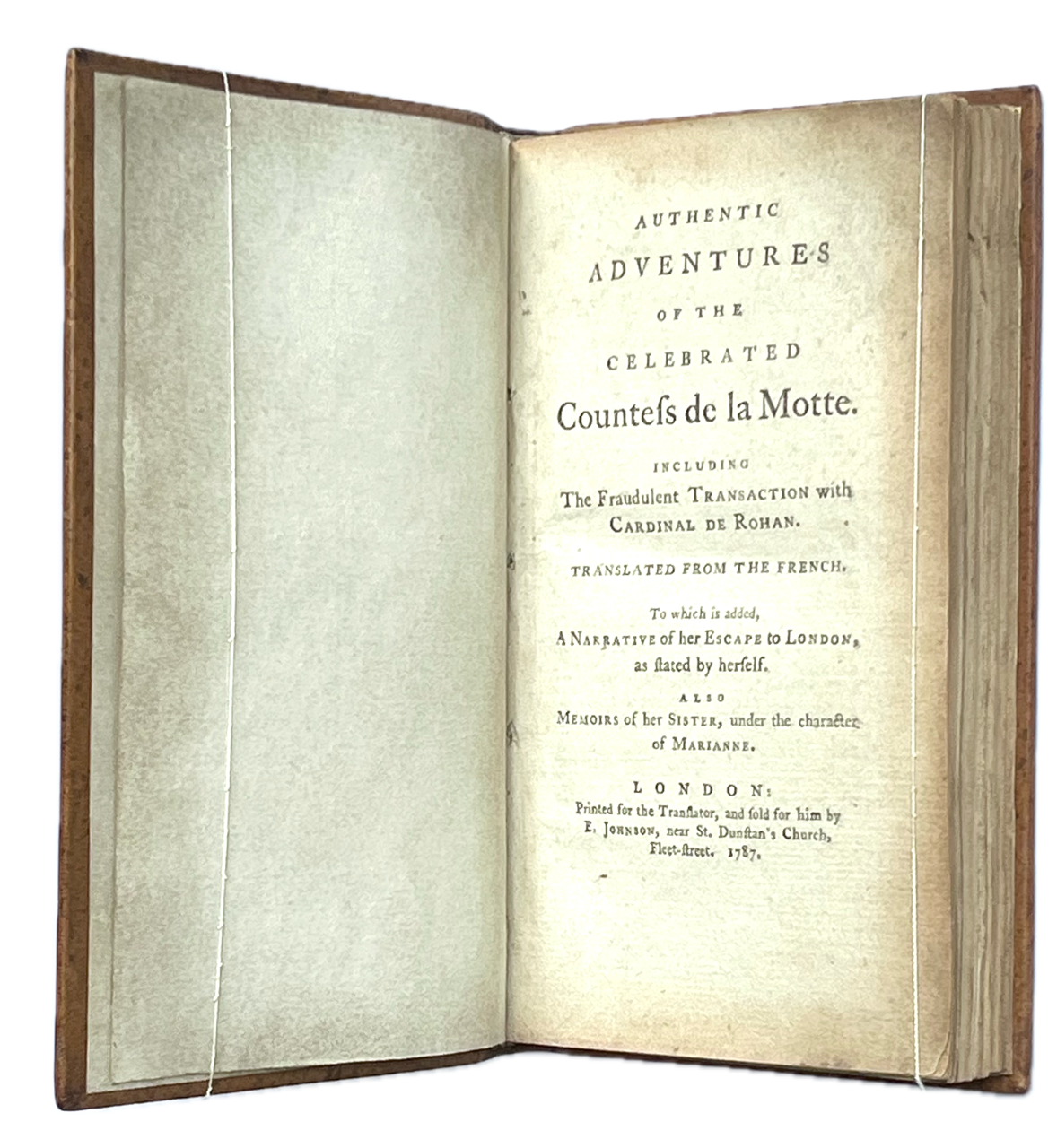
COUNTESS DE LA MOTTE [Jeanne de Valois-Saint-Rémy]. Authentic Adventures of the Celebrated Countess de la Motte, Including the Fraudulent Transaction with Cardinal de Rohan. Translated from the French. To which is added, A Narrative of her Escape to London as stated by herself, also Memoirs of her Sister, under the character of Marianne. London; Printed for the Translator and sold for him by E. Johnson, near St. Dunstan’s Church, Fleet-Street. 1787.
£1,500.00
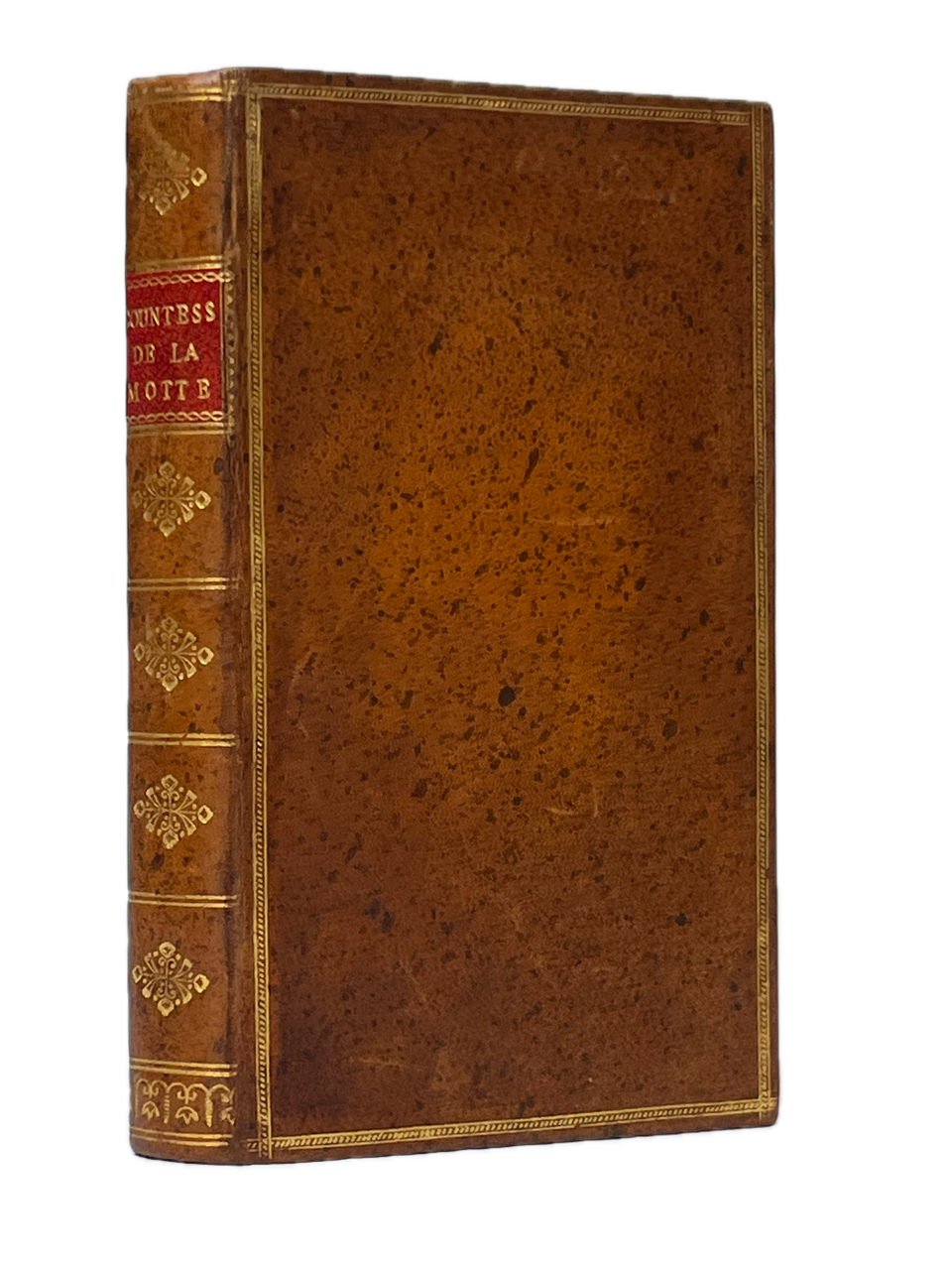
Demy 8vo.; sometime prettily bound in period style in full specked tan roan with decorative gilt filet to sides, flat spine ruled and gilded in compartments with onlaid red leather label neatly tooled in gilt; pp. [ii], i-xii (preface) + 163, on laid paper (bound without half-title); externally near fine with a delightful gentle patina, internally very clean and fresh throughout with only a couple of small spots, some soiling to top edges, tanning to margins of title-page, occasional light thumbing, and one unremarkable closed top edge tear; very scarce, especially in commerce.
First edition.
This is the first account of the sensational Diamond Necklace Affair (1784-1785) at the court of Louis XVI. This incident served to undermine public trust in the reputation of Queen Marie Antoinette, and create unrest in the years leading up to the French Revolution.
The background to the major French scandal began in 1772 when the previous king, Louis XV, commissioned an exorbitantly expensive diamond necklace from the jewellers Charles Auguste Boehmer and Paul Bassenge, for his mistress Madame du Barry. Louis died in 1774 before the jewel was completed, and before paying for it in full, leaving the makers in a precarious financial position.
They approached the new king, suggesting a gift for Marie Antoinette, but she reportedly twice refused it, on the grounds of expense.
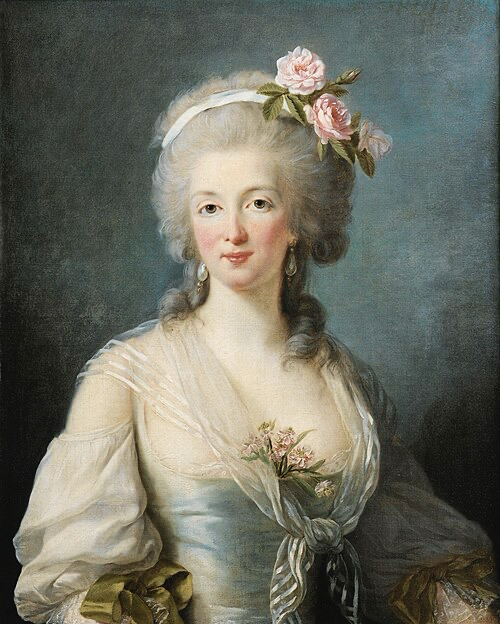
A scheme was then dreamt up by Jeanne de La Motte, born Jeanne de Valois-Saint-Rémy, who was a manipulative fraudster from a faded noble lineage. She befriended the Cardinal Louis de Rohan, the Grand Almoner of France, who had recently fallen out with Marie Antoinette and her mother and was eager to regain favour. She persuaded the Cardinal that Marie Antoinette secretly desired the jewel but needed to buy it discreetly and, with the assistance of forged letters and a prostitute disguised as the queen herself, convinced him to act on her behalf and procure it. He did, on the understanding it would be paid for in instalments and handed it to La Motte, as intermediary. She and her accomplices then broke up the piece and sold the diamonds, mainly in London, to fund their lavish lifestyles. The Cardinal was arrested as he prepared to say mass. Jeanne de la Motte was later convicted, flogged, and branded “V” for voleuse, but managed to escape to England where she wrote scandalous memoirs attacking the queen. The self-styled Countess de la Motte was a notorious figure in her day, later inspiring books, films and histories about the end of the French monarchy. The artist Élisabeth Vigée Le Brun painted a portrait in oils said to be of Jeanne de Valois, Comtesse de la Motte.
The whole affair was widely seen to discredit the ancien régime and is believed to have fuelled revolutionary sentiment in the lead-up to the French Revolution.
In stock
Related Products
-
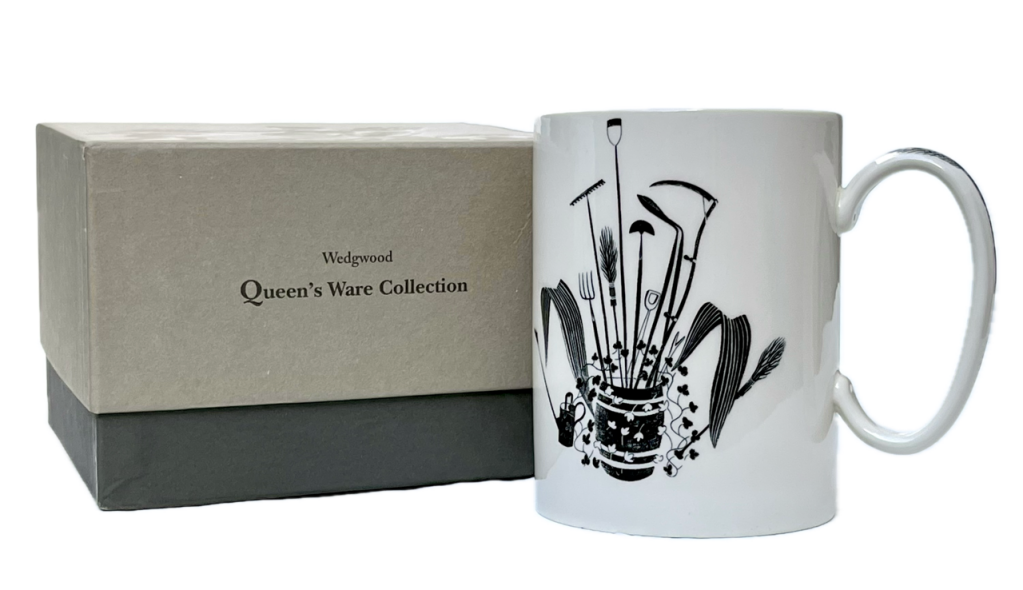
[RAVILIOUS, Eric, designer.] ‘Garden Implements’ mug. [London] Wedgewood, Queen’s Ware Collection.
£120.00 -
![["Hold to Light" theatre handbill.] Wedding Eve. Comic Opera Every Evening at 8.15. The Trafalgar Square Theatre.](https://www.rosiehodgebooks.co.uk/wp-content/uploads/2025/10/IMG_4462-768x1024.png)
—– [“Hold to Light” theatre handbill.] Wedding Eve. Comic Opera Every Evening at 8.15. The Trafalgar Square Theatre. Nottingham; Grover & Co. 1892
£120.00 -
![[A pair of handmade Victorian optical shades.]](https://www.rosiehodgebooks.co.uk/wp-content/uploads/2026/08/IMG_0267-1024x832.png)
Optical toys
____ [A pair of handmade Victorian optical shades.] 1870s.£550.00 -
Art Deco
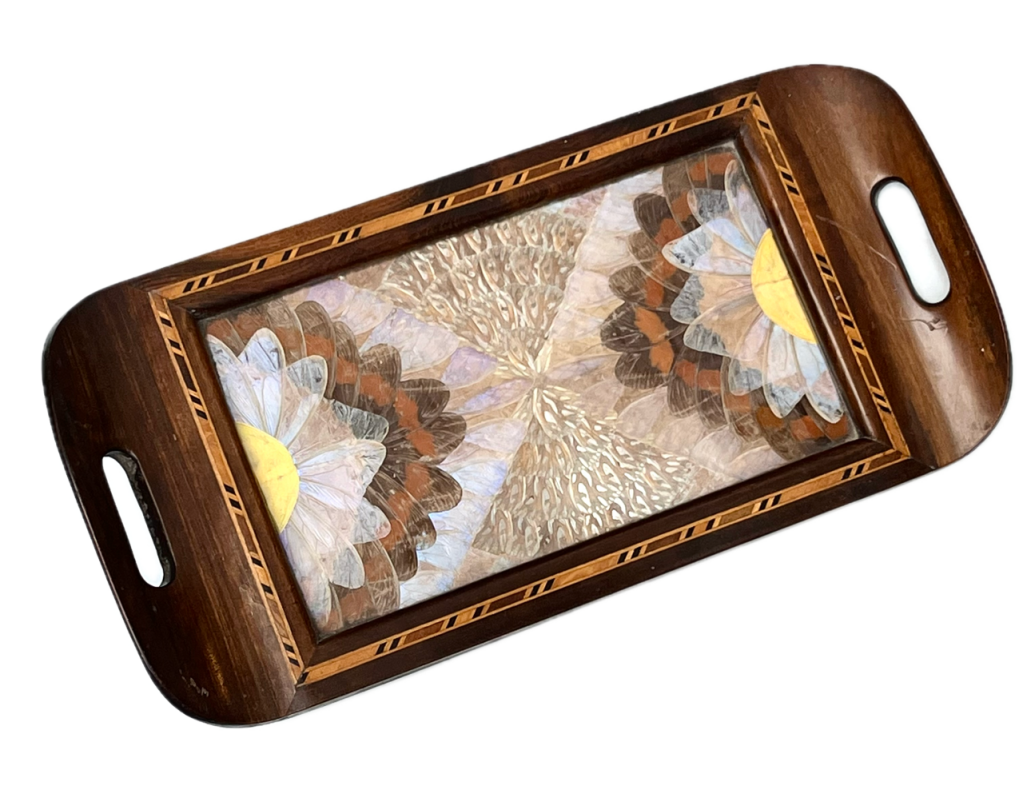
—– 1930s’ Brazilian butterfly-wing drinks’ tray. Rio [de Janeiro], Brasil. Zitrin Irmaos. [1930s]£95.00