

Owned by a well-known Victorian comic.
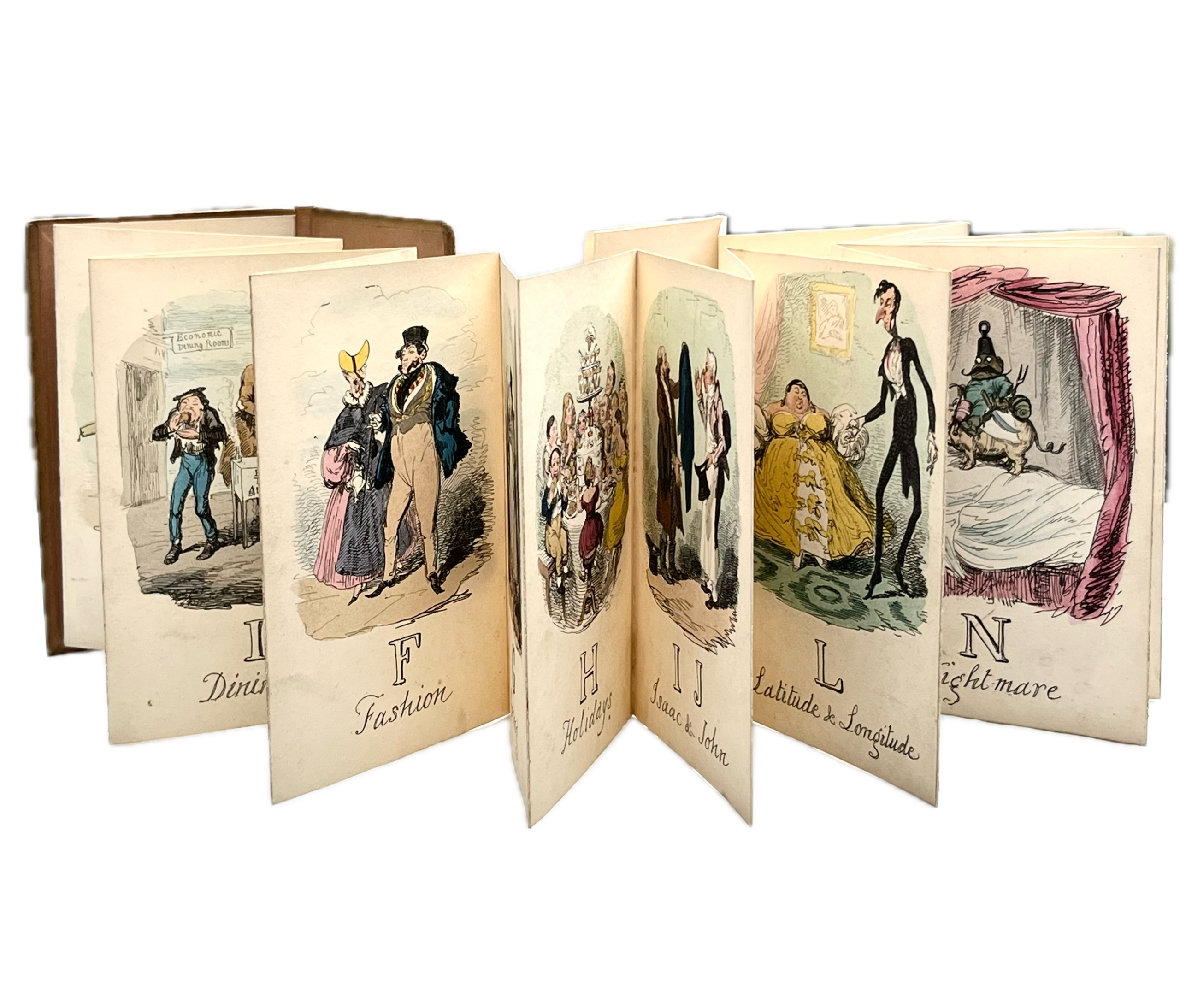
CRUIKSHANK, George (illustrator). A Comic Alphabet. Designed, Etched and Published by George Cruikshank. London No. 23, Myddleton Terrace, Pentonville. 1837
£1,200.00
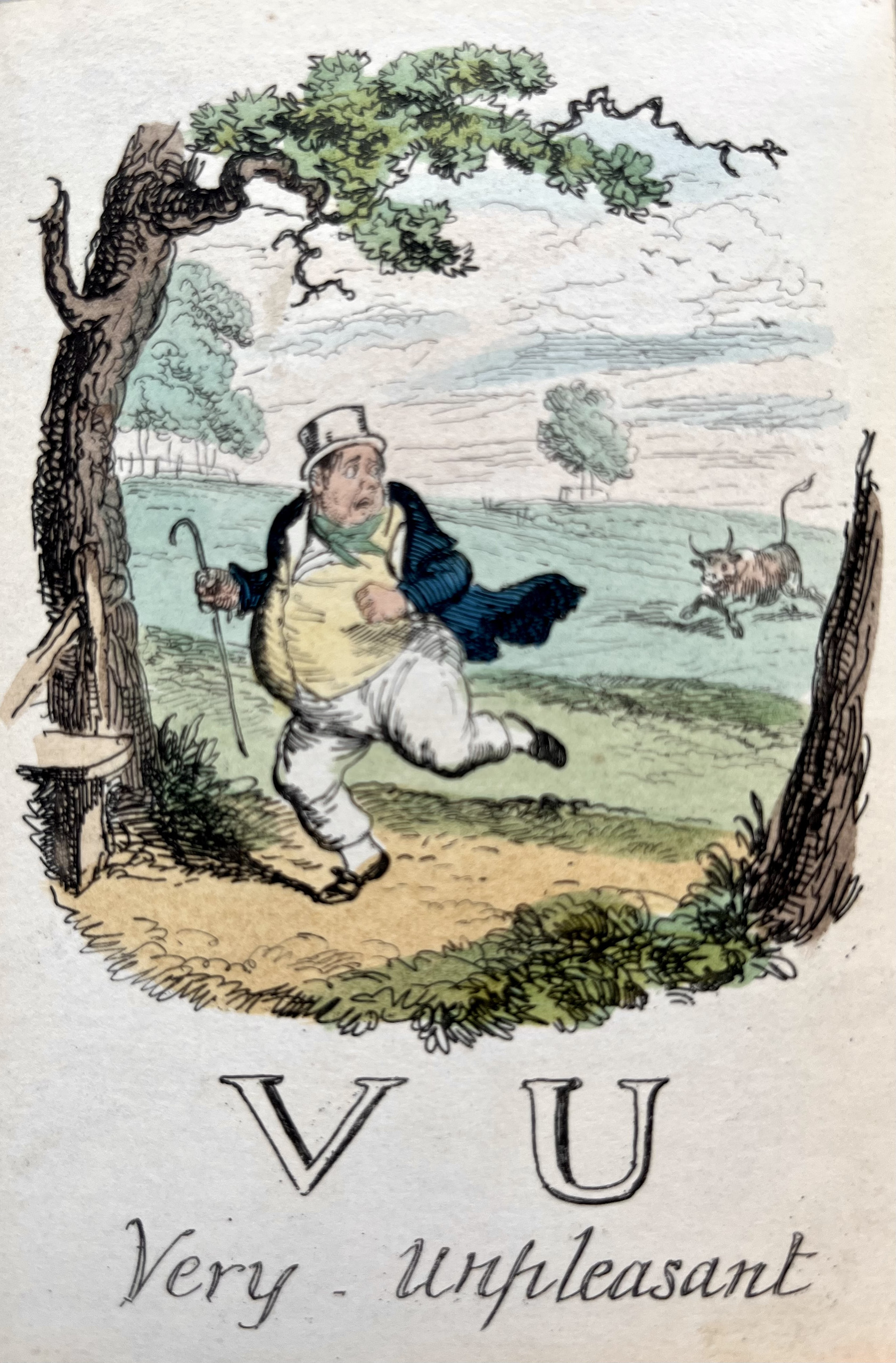
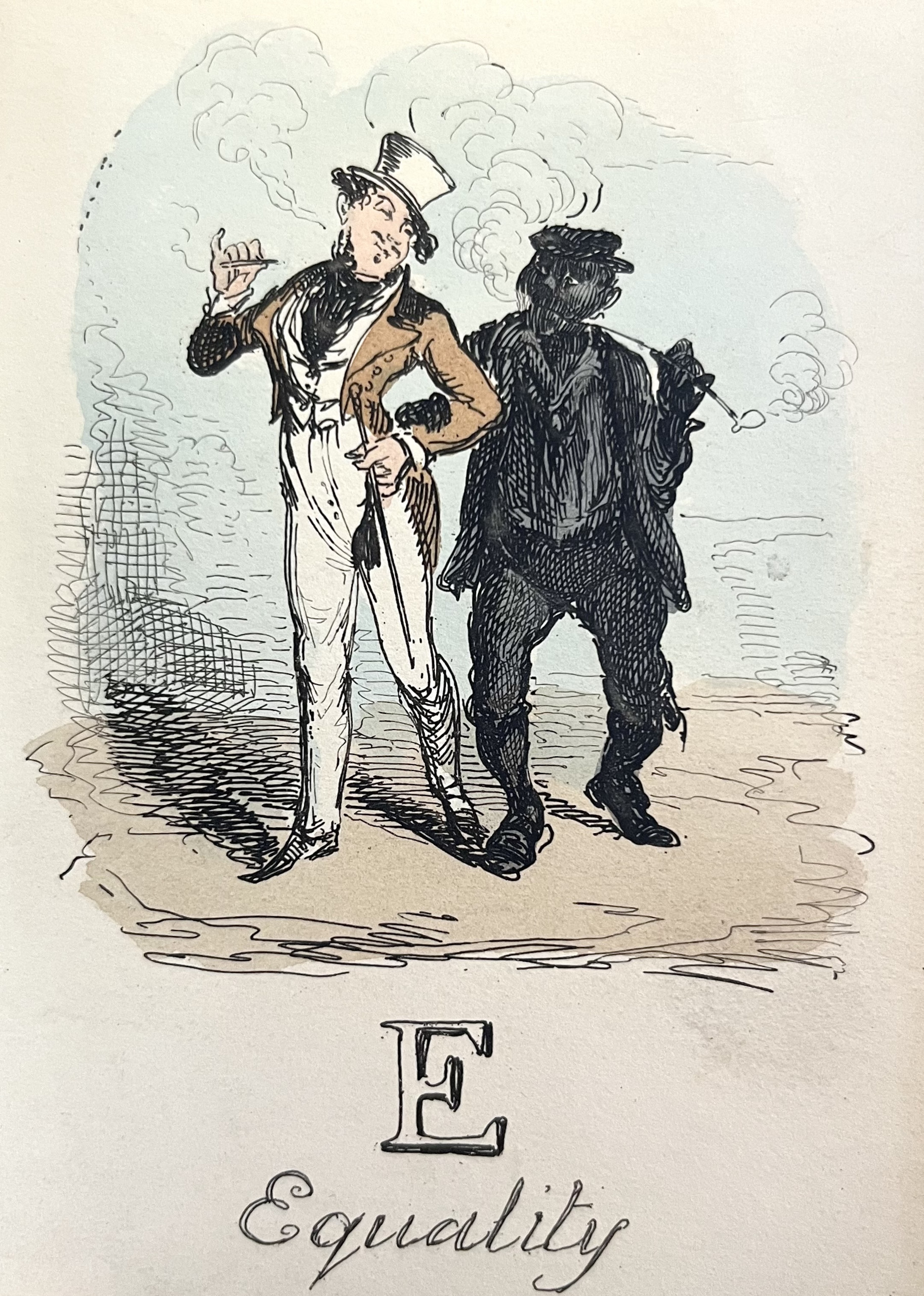
24mo.; original taupe-coloured boards pictorially printed in black to both covers with T for Tilt, 86 Fleet Street, to lower board, lettered black to spine, original peach-brown endpapers, containing a 24-leaf accordion-folded pull-out book or leporello, each page with a humorous etched plate by Cruikshank to represent a letter of the alphabet: A for A la mode; B for Boots; C for Chimpanzee; D for Dining Out; I and J share a page (Isaac & John) as do V and U (reversed for Very Unpleasant), each plate with pretty original handcolouring; a lovely example in refreshingly bright, clean condition with only light external dusting, a small scuff, and minor rubbing to spine ends, to upper board, and to edges; internally fine and crisp with colouring clear, neat, and lively, and with a small calligraphed ink inscription, “Charles Collette, Covent Garden, London, N[ovembe]r. 1875”.
First handcoloured edition, issued one year after the first (uncoloured) edition, by the same publisher. The rear cover showed an etched portrait of Charles Tilt in his bookshop with an advertisement poster for “The Comic Alphabet”, dated 1837, on the wall behind him.
Charles Henry Collette (1842-1924) the one-time owner of this little work, was an English stage actor, composer, and writer known for his 4-decade-long career on stage and for his work in comedy. He appeared in many Bancroft productions, beginning in the 1860s and also performed in his own companies, embodying characters from Shakespeare, Sheridan, and Robertson and appearing in adaptations of Dickens novels. He died in his home near Kew Gardens at the age of 81.
The prominent London-based bookseller and publisher Charles Tilt (1797-1861) achieved great success in his career. He began apprenticed to a bookseller in Hampshire but moved to London to work for Hatchard’s and Longmans & Co. In 1826 he established his own publishing business and specialised in quality illustrated books, miniature editions,, and folding books or booklets, which became a fashion at the time. He amassed great wealth from his endeavours leaving an estate worth £180,000.
In stock
Related Products
-
![[Old World Palm. An original copperplate etching.]](https://www.rosiehodgebooks.co.uk/wp-content/uploads/2025/09/1363-600x800.png)
VAN SANDWYK, Charles (illustrator). [Old World Palm. An original copperplate etching.] [North Vancouver] [CVS Fine Arts.] Signed
£400.00 -
![A Book of Mediterranean Food [and] French Country Cooking.](https://www.rosiehodgebooks.co.uk/wp-content/uploads/2026/03/IMG_8062-600x800.png)
First combined edition.
DAVID, Elizabeth (author). John MINTON (illustrator). A Book of Mediterranean Food [and] French Country Cooking. London; The Cookery Book Club. 1968£130.00 -
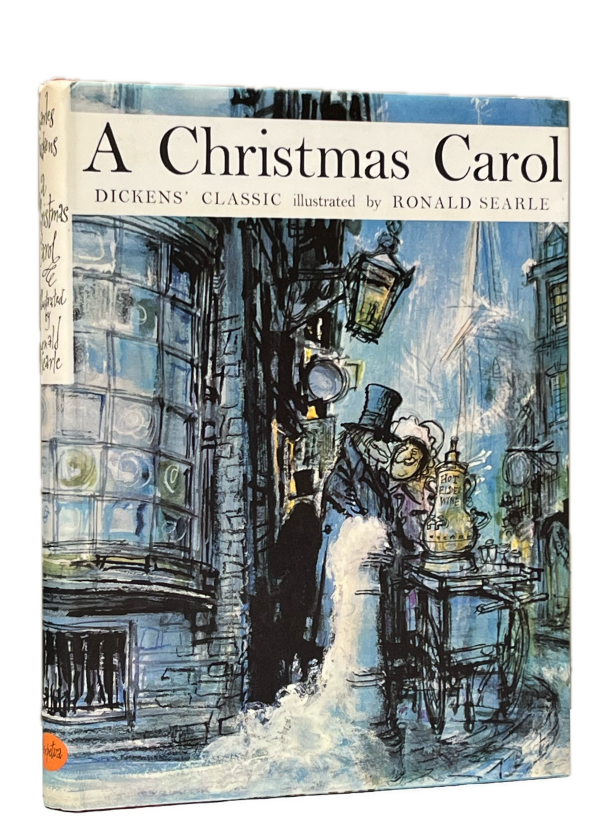
DICKENS, Charles (author). Ronald SEARLE (illustrator). A Christmas Carol. London Perpetua Books. 1961
£120.00 -
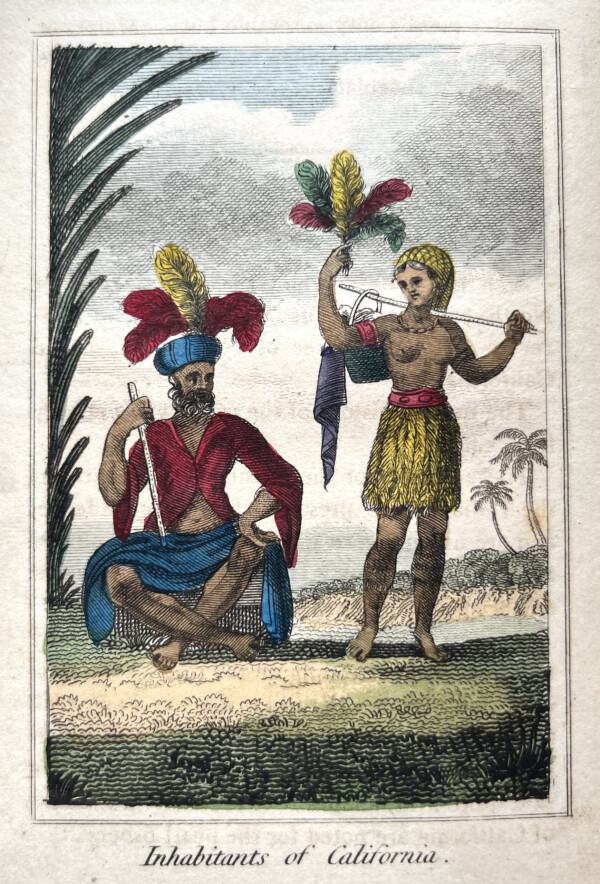
[VENNING, Mary]. A Geographical Present Being Descriptions of the Principal Countries of The World: with Representations of the Various Inhabitants In Their Respective Costumes. Beautifully Coloured. London Printed for Darton, Harvey And Darton, Gracechurch-Street. 1817
£300.00